Search This Website

Showing posts with label TECHNOLOGY. Show all posts

Tuesday, 19 December 2017

Google, NASA find alien planet using machine learning

"There are other worlds than these."


Scientists have discovered an eighth planet circling the sunlike star Kepler-90, 2,545 light-years away. This means that our solar system and Kepler 90 are now tied for the most number of known planets within a star system.

So yeah, maybe we're not that special after all.

The newfound planet, named Kepler-90i, was found using machine learning technology from Google that effectively teach a computer to spot patterns in large datasets.


In this case, the dataset was compiled of signals spotted by NASA's planet-hunting Kepler Space Telescope, which discovers planets by spotting the slight dips in a star's light that happen when a planet passes in front of its star from Earth's perspective. That movement is called a transit.

Astronomer Andrew Vanderburg and Google’s Christopher Shallue trained the artificial intelligence by first showing it how to pick out transits from 15,000 signals they already knew were from actual exoplanets, NASA said.

After that, they moved on to the hard stuff. Vanderburg and Shallue then used the technology to look at the data from 670 other star systems that they knew had planets to find any other worlds that may be lurking in the data.


The Kepler 90 system.  

Kepler-90i is one of those worlds.

“We got lots of false positives of planets, but also potentially more real planets,” Vanderburg said in a statement. “It’s like sifting through rocks to find jewels. If you have a finer sieve then you will catch more rocks but you might catch more jewels, as well.”

Scientists also found another planet, Kepler-80g, circling a star with five other planets orbiting it. Kepler-90i isn't the kind of place you want to jet off to for a quick vacation, however.

While the world is rocky, it's also exceedingly hot. The planet completes an orbit of its star once every 14.4 Earth days and likely has an average surface temperature of about 800 degrees Fahrenheit.

The Kepler 90 system is also very different from our own.

If all eight planets in that system were moved into our solar system, they would all fit within Earth's orbit. In other words, all of the planets are closer to Kepler 90 than our Earth is to the sun, according to NASA.

“These results demonstrate the enduring value of Kepler’s mission,” Jessie Dotson, Kepler’s project scientist, said in the statement.

“New ways of looking at the data — such as this early-stage research to apply machine learning algorithms — promises to continue to yield significant advances in our understanding of planetary systems around other stars. I’m sure there are more firsts in the data waiting for people to find them.”

Monday, 18 December 2017

Spotify’s valuation jumps 20% to $19 billion in private trading


(Reuters) — The value of music streaming service Spotify, which is planning a stock market listing, has grown around 20 percent to at least $19 billion in the past few months, outperforming U.S. and European tech indexes, sources familiar with the matter said.

The most recent private trades in the Swedish company have taken place at above $4,000 per share according to sources.

One of the sources said the recent trades were at a record-high of $4,200, valuing the firm at $19 billion or more. That compares to around $16 billion earlier this autumn.

Spotify is aiming to file its intention to float with U.S. regulators toward the end of this year, sources said.

Also supporting perceptions of Spotify’s increasing value, Tencent’s purchase of new Spotify shares implies a valuation of $5,000 per share, one of the sources said.

Spotify and the music arm of China’s Tencent Holdings Ltd said last week they would buy minority stakes in each other, but gave no financial details.

Spotify did not immediately respond to inquiries about valuation and listing.

The private market for shares prior to a public listing allows employees and founders of private companies such as Spotify to cash in on some of their paper wealth, while letting other investors get a head start on the listing.

Spotify’s valuation when it lists – expected to be within 90 days after filing – is forecast to be a few billion dollars higher than current trades as illiquidity risk tends to depress the value ahead of listing, the sources said.

While several big tech firms have struggled to enter China, Spotify has with the Tencent deal secured an exposure to the growing Chinese music streaming market.

Spotify is the biggest global music streaming company and counts tech giants Apple and Amazon as its main rivals.

The timing for its filing with the U.S. Securities and Exchange Commission in December is roughly in line with what has been previously suggested by sources.

Spotify aims to pursuing a so-called direct listing on the New York Stock Exchange, allowing existing investors to sell shares without raising money from new ones, sources have previously told Reuters. The move is also aimed at saving hundreds of millions of dollars in underwriting fees from investment banks.

As messaging apps embrace ‘unsend’, Twitter can only ignore ‘edit tweet’ demands for so long


Everyone’s been there. A rushed, fat-fingered message to your friend, reminding them to bring the “monkey” they owe you for that concert ticket.

There are, of course, far worse autocorrect calamities, which is why mobile messaging companies the world over are caving to demands for remediation tools.

Today, Asian messaging giant Line revealed it was appeasing its 200 million users with a new feature that lets them “unsend” a message within a 24-hour period, both in group chats and one-to-one conversations. This is in addition to the existing “delete” feature, which allows users to remove a message on their own side, though who really wants to delete a message just from their own device?


Line’s move echoes those of several other messaging companies in 2017. Back in January, Telegram began allowing message removals within a 48-hour period. This option was introduced eight months after a new feature that lets Telegram users edit messages after they’ve been sent.

Back in October, Facebook-owned WhatsApp caved to popular demand by finally allowing its billion-plus global users to permanently remove a messagefrom all recipients within seven minutes of sending it. Sure, that won’t give you enough time to reverse a drunken retort from the night before, but it at least allows you to backtrack on a hastily constructed utterance sent in the heat of the moment.

Listen up

So it seems messaging companies the world over are listening to their users, who have made it clear they want to be able to remedy any regrettable message they’ve sent, whether by editing or deleting it.

Against this backdrop, Twitter yesterday announced a new feature in support of threads, something that will basically better enable tweet storms. But whenever Twitter rolls out a new feature, the same response comes in droves — “nice new feature, but what we really want is the ability to edit tweets.”

Facebook launches snooze button so you can hide annoying friends for 30 days

Everyone has a Facebook friend they find annoying, whether because they post terrible dad jokes, spout political nonsense, or simply have dissimilar views and interests. While there are already ways to hide those people from your timeline without unfriending them, Facebook is now rolling out a new feature that lets you temporarily unfollow any of your buddies for 30 days.

The new snooze feature also works with Pages and Groups, so if you’re sick of a particular publication’s posts about a sporting event you have no interest in, you can cut off contact for a month.

Join Our Whatsapp Group To Get Daily Updates 


Facebook has actually been testing the snooze option for a few months, though the company seems to have made some tweaks to the feature since it was first debuted. For instance, in its original guise, the snooze feature was bundled in alongside the existing unfollow feature, meaning you had to tap the “unfollow or snooze” option from the dropdown box and then select whether you wanted to permanently unfollow (but not unfriend) the party, or just temporarily mute their messages.

Additionally, it seems that Facebook was originally going to allow users to snooze people, Pages, or Groups for a day, a week, or a month. Now, it’s a simple one-tap decision — do you want to mute your pal Peter for 30 days… or not?

“We’ve heard from people that they want more options to determine what they see in News Feed and when they see it,” noted Facebook product manager Shruthi Muraleedharan, in a blog post. “With Snooze, you don’t have to unfollow or unfriend permanently, rather just stop seeing someone’s posts for a short period of time. The people, Pages, and groups you snooze will not be notified. You will be notified before the Snooze period is about to end, and the setting can also be reversed at any time.”


Saturday, 16 December 2017

Artificial intelligence just discovered two new exoplanets

Artificial intelligence just discovered two new exoplanets


NASA exoplanets

A machine learning technique called a neural network has identified two new exoplanets in our galaxy, NASA scientists and a Google software engineer announced today, meaning that researchers now know about two new worlds thanks to the power of artificial intelligence.
Discovering new exoplanets—as planets outside our solar system are called—is a relatively common occurrence, and a key instrument that scientists use to identify them is the Kepler Space Telescope, which has already spotted a confirmed 2,525 exoplanets. But what’s novel about this announcement is that researchers used a AI system to spot these two new worlds, now dubbed Kepler-90i and Kepler-80g. The planet known as 90i is especially interesting to astronomers, as it brings the total number of known planets orbiting that star to eight, a tie with our own system. The average temperature on 90i is thought to be quite balmy: more than 800 degrees Fahrenheit.
Just as exoplanet discoveries are common, so too are neural networks, which is software that learns from data (as opposed to a program that have had rules programmed into it). Neural networks power language translation on Facebook, the FaceID system on the new iPhone X, and image recognition on Google Photos. A classic example of how a neural network learns is to consider pictures of cats and dogs—if you feed labeled images of cats into a neural network, later it should be able to identify new images that it thinks has cats in them because it has been trained to do so.

Friday, 15 December 2017

Google Home Max review

Hands on: Google Home Max review

The Google Home Max turns the Google Assistant into your very own personal DJ. Well, the same can be said about the Google Home and the Google Home Mini, but the Max is the only one suited to rock the house thanks to its impressive hardware.
But of course, this is Google we're dealing with, so you'll also find a hearty dose of artificial intelligence smarts built into the Max. This, in a way, plays just as crucial a role in delivering your music in a crisp, room-filling manner.
It's tough to convey the worthiness of an audio product, especially one that claims to take things to the "Max" as this one does. But as someone who has reviewed many headphones and Bluetooth speakers, I can confidently say that there's something special here.
We didn't have a chance to test the Max outside of Google's controlled environment, but the demo that showed off what a single Max could do, as well two paired up, left us wanting more.
Google Home Max price and release date
The Max debuted in the US on December 11 for $399 (around £300 / AU$510) and unfortunately for our friends outside of the US, it's not making its way outside of North America just yet.
It was a similar story when the original Google Home was first announced. Like the Max, the speaker was originally exclusive to North America, before making its way to other territories after around six months. 
Although a day-in-date release worldwide would be preferable, we hope that people in other territories won't have to wait long to see the Max released.
Design
 The Google Home Max piggy-backs on the look of the other Home models in that it keeps it super simple on the design front. Unlike the others, you'll know this is a speaker right away, but Google has worked in a bit of elegance here to make its hefty 11-pound build work in its favor.
Across the front is a mesh fabric that hides the drivers. On the Max's top, you'll see a small line that indicates the location of the speakers touch-friendly sensor that's used for adjusting volume controls and skipping throughout your favorite album, that is, unless you'd rather do it with your voice.
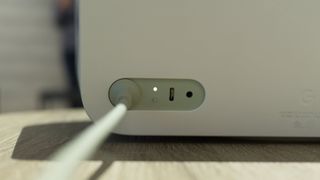
The speaker's rear plays host to a few features. There's an on/off switch right in the middle, but near the corner is where the included power supply plugs in. Next to it, there's a 3.5mm jack to output to your preferred device, as well as a USB-C port, which I'm told is used for piping in an ethernet connection. Google didn't state if it was including one in the box.
One of Max's more interesting features is that it doesn't feature permanent rubber feet. It can stand either horizontally or vertically without scuffing the table (or the Max itself) thanks to its magnetic rubber platform that can easily be taken off and relocated to shift its orientation.
Performance
Equipped with two custom 0.7-inch tweeters and two 4.5-inch dual-excursion woofers, the Max impresses right out of the gate. As we mentioned, the Max was demonstrated in a controlled environment, so we're really looking forward to testing this out in a bunch of different environments.


Needless to say, an 11 pound speaker is capable of so much more than the other Google Homes, but we were really impressed with just how loud the speaker got, all without showing any signs of reaching a threshold. 
To that end, each and every slice of the music profile sounded crisp, clear and without compromise in the sound delivery – and this was just with an MP3. We'd love to try this out with a vinyl record.
Google's Smart Sound technology utilizes artificial intelligence to dynamically shift the delivery of your tunes. This can be based on room size, obstacles in the room, time of day, and where the Max is located in the room. Much like the Apple HomePod, Google is really touting the smarts in this speaker as being just as central to the experience as the hardware is.
Early verdict
With the Max, there's now a Google Home suited for all sorts of living quarters – from the bedroom, the kitchen and the garage. This one just so happens to be about rocking louder and being smarter than the others.
Coming in at $399, this isn't as easy to plunk down on as the other Home models – especially when stacked up against the $49 Google Home Mini – but doing so means treating yourself to deeper, louder and smarter experience. 

Thursday, 14 December 2017

NVIDIA Introduces GeForce GTX G-Assist

NVIDIA Introduces GeForce GTX G-Assist For AFK Gaming!


Today NVIDIA announced the GeForce GTX G-Assist, which takes advantage of cutting-edge NVIDIA Artificial Intelligence technology to deliver the next revolution in PC gaming.
Based on a new custom GeForce SoC (Supercomputer on a Chip), the GeForce GTX G-Assist helps you easily eliminate “away from keyboard” (AFK) scenarios, overcome the toughest boss battles, and monitor and maintain your peak gaming performance.


In addition, our new artificial intelligence engine, called “GeForce Assisted Gaming” has already been trained to play and win 10,080 games and provides you the support to win even more. New gaming features include:
    • GeForce GhostPlay–You’re 3v4 in an intense round of Rainbow Six Siege, but suddenly there’s a knock at the door. Pizza is here. You can’t abandon your team, but that delivery guy isn’t going to wait forever, so you go AFK. With GeForce GhostPlay you’ll never have to compromise again. Next time you need to step away from your PC, AI-enabled GhostPlay will take over, playing at your skill level for a few minutes until your return. You get your pizza, your team gets your invaluable skills.

    • Boss Boost™–Given up on beating the Nameless King in Dark Souls 3? With Boss Boost, you no longer have to cower in fear when facing down a god of war. Available once per game, Boss Boost will crush any enemy you desire and automatically turn on ShadowPlay, so you can share your ‘victory’ with friends.

    • NVIDIA Nurture–a landmark intersection of self-care and gaming. Our AI anticipates the needs of a PC gamer and will automatically have food delivered, keep a steady supply of GeForce GTX ENERGY on-hand, and even order thoughtful gifts for your significant other.

    • GeForce GameTrain–Starting a new game can be a daunting experience, especially if you’re looking to level up quickly. But watching YouTube tutorials can only go so far. With GeForce GameTrain you can now learn from the best game player in the world, honing your skills in-game with helpful pointers and visual cues.

    GeForce GTX G-Assist with NVIDIA AI technology will be available later this year from the GeForce Partner Network, which represent a global network representing over 238 countries and territories. Pricing will be announced closer to launch.